
Understory by Paris Kirby
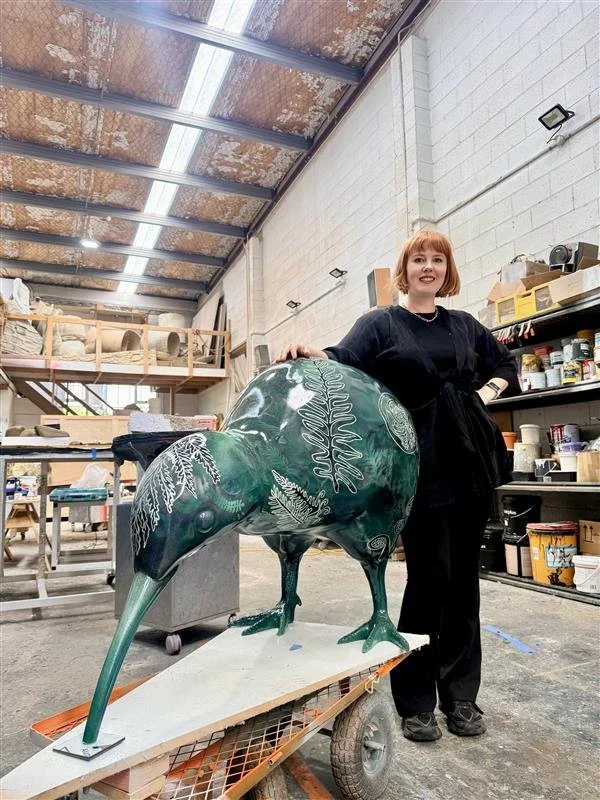
Paris Kirby is an artist, designer, and placemaker based in Auckland, New Zealand. A leader in the arts and cultural industry, she is passionate about integrating art into public spaces and empowering communities. Her work is inspired by local environments and explores themes of connection, place, and storytelling.
Describe the inspiration behind your kiwi.
This year, my starting point was the kiwi as a symbol of cultural identity - not just as an emblem of Aotearoa, but as a living presence within a layered landscape of history, ancestry, and place. The work prompted me to reflect on my own identity as a Pākehā New Zealander with Scottish, British, and Scandinavian heritage, and to consider what it means to belong to a place while carrying ancestral memory from elsewhere.
I was interested in the feeling of looking up at the stars at night and knowing that generations before us would have seen the same sky - a quiet, nostalgic connection across time. Celtic and Pictish symbols appear in the lower layers of the work, not as something overt or dominant, but as traces: still present, not forgotten, embedded like DNA or memory.
These elements are woven together with my ongoing use of native ngahere forms, situating the kiwi within the nocturnal New Zealand bush. Ultimately, the work is an exploration of identity, inheritance, and belonging - held gently within the environment the kiwi calls home.
Describe the design process. How did your idea turn into a kiwi?
The work was developed through a deliberate process of layering - building up and then partially obscuring imagery, text, and symbolism over time. I combined motifs from the native bush, fragments of poetry inspired by the kiwi’s nocturnal world, and ancient symbolic forms drawn from my ancestral lineage.
This layering approach allowed me to think about identity in a similar way to DNA: accumulated, altered, and revealed over generations. Some elements are clear, others are hidden beneath the surface, creating a sense of time, erasure, and evolution.
The palette of silver and green was chosen to evoke moonlight moving through the forest at night - calm, quiet, but with a strong presence. I wanted the sculpture to feel grounded and reflective, holding a sense of stillness while also carrying depth and complexity.
What's your favourite thing about your sculpture? What makes it super cool?
I love the subtlety of the work - the way it reveals itself slowly. There are layers of meaning, imagery, and text that aren’t immediately obvious, and I enjoy the idea that the sculpture rewards closer looking. The deeper you spend time with it, the more stories begin to emerge.
Why did you say 'yes' to joining the Kiwi Art Trail?
I was drawn to the Kiwi Art Trail because it allows art to speak to something larger than itself. The opportunity to contribute to a cause that aligns with my values gives the work a deeper sense of purpose.
I’m also interested in art that exists outside traditional gallery spaces - work that meets people where they are, invites curiosity, and reaches new audiences. The trail creates meaningful connections between art, place, and community, which is something I care deeply about.
What do you like about kiwi and kiwi conservation? Why is the kiwi important to you?
The kiwi represents both rarity and resilience. Its vulnerability mirrors the fragility of the environments it inhabits - ecosystems that carry immense ecological, cultural, and spiritual value.
Protecting the kiwi means protecting the forests, soils, and habitats that sustain life more broadly. These places are taonga, and their care is inseparable from how we care for future generations. At a time when species are being lost globally, I’m inspired by the idea of being part of a country that values and protects its native world. That commitment feels central to who we are, and it’s a story I feel compelled to contribute to through my work.
Have you ever seen a kiwi?
I’ve seen a kiwi only a few times - once in the wild at Waikaremoana, and also at Ōtorohanga Kiwi House and Zealandia in Wellington. What struck me most was their physical strength and quiet persistence. Despite their fragility, they have a solid, determined presence. There’s also a sense of character and humour to them, which makes encounters feel deeply human and memorable.
Why do you do what you do? What inspired you to become an artist?
I’m deeply drawn to the process of making - the act of painting as both problem-solving and reflection. I love exploring how colour, texture, and form can create visual experiences that hold emotion, memory, and meaning.
For me, making art is a way of paying attention: to place, to material, and to the subtle things that often go unnoticed. If the work can bring beauty into the world while also inviting reflection and care, then it feels worthwhile.
Find out more about Understory here.
